
Begin a Mackinac County Property Records Search
Start with the fact least likely to have changed. For most land, that is the street address. The Fetch EUP parcel viewer can find a tax parcel several ways. Search by owner name, street address, intersection, coordinates, or parcel number. Once the map lands on the right parcel, save its PIN, tax description, owner or mailing field, and the date you viewed it.
- Locate the parcel by address, map point, owner, or PIN.
- Match the physical address to the legal or tax description.
- Check values and tax-year fields through the county-linked assessment search.
- Carry the party name or description to the Register of Deeds index.
- Order the instrument or contact the custodian if the online result is incomplete.
That order of operations prevents two common mix-ups. A mailing label is not a legal description. A tax-roll name is not conclusive title. Mackinac County property records are most reliable when two or more official layers agree with each other.
Fetch Connects Mackinac Parcels to Their Records
Fetch is the county's widest discovery lens. It layers imagery, measurement, buffer, print, report, CSV, and label tools over the parcel base. The parcel report lays out property and owner addresses, acreage, zoning, frontage, depth, land value, tax description, sales, building details, tax history, and delinquent-tax data. Some fields may sit empty for a given parcel. The county also publishes no fixed refresh schedule for the data.
| Search route | Input shown | Useful result |
|---|---|---|
| Street | Street address | A likely mapped parcel |
| Owner | Owner name text | Parcels tied to a name form |
| Parcel | Four grouped PIN boxes | An exact tax-map unit |
| Place | Intersection or coordinates | Land lacking a reliable address |
For bigger jobs, the official Mackinac County GIS page posts data-request and fee details that reach beyond a single parcel lookup.
Where Mackinac County Keeps Property Records
Most custodians sit together at the courthouse at 100 S. Marley Street in St. Ignace, but the right office depends on the question. The Register records deeds and other instruments affecting land. Equalization coordinates county assessment work. It also ties the assessment and tax search together. The Treasurer manages delinquent real-property tax, foreclosure, and auction routes. The courts keep the cases and orders. Those records can alter a parcel's status.
Register of Deeds
Deeds, mortgages, land contracts, plats, releases, financing statements, and recorded court orders. Phone 906-643-7306.
Equalization
Assessment reports, assessor contacts, land-division links, and the county property-search route. Room 120, phone 906-643-7310.
County Treasurer
Delinquent taxes, foreclosure administration, payments, and parcels offered through the current auction process. Room 30, phone 906-643-7318.
GIS
Parcel layers, Fetch access, traditional maps, GIS datasets, and data-use requests. Map lines remain informational.
City and township assessors handle much of the parcel-level work. Assessment notices, exemptions, and Board of Review matters usually start there, so county and municipal channels complement each other in Mackinac County.
The Mackinac Register's Working Index
The Mackinac County LandWeb index is free and searchable by name, description, or recorded date. The county says new documents are typically indexed within two working days. It also calls the database a working index. That index is constantly edited and may contain errors. So a blank result is not a dead end. Try spelling variants, another description fragment, or a wider date window before calling the office. LandWeb traces the recording trail, not just the tax parcel. Use it to link a current grantee to the prior grantor. Then follow the mortgages, releases, easements, plats, land contracts, and court or probate orders. Those documents share the parties or legal description. Copies can be bought by credit card. The office takes counter and mailed requests too. The official LandWeb search screen shows these entry routes plainly.
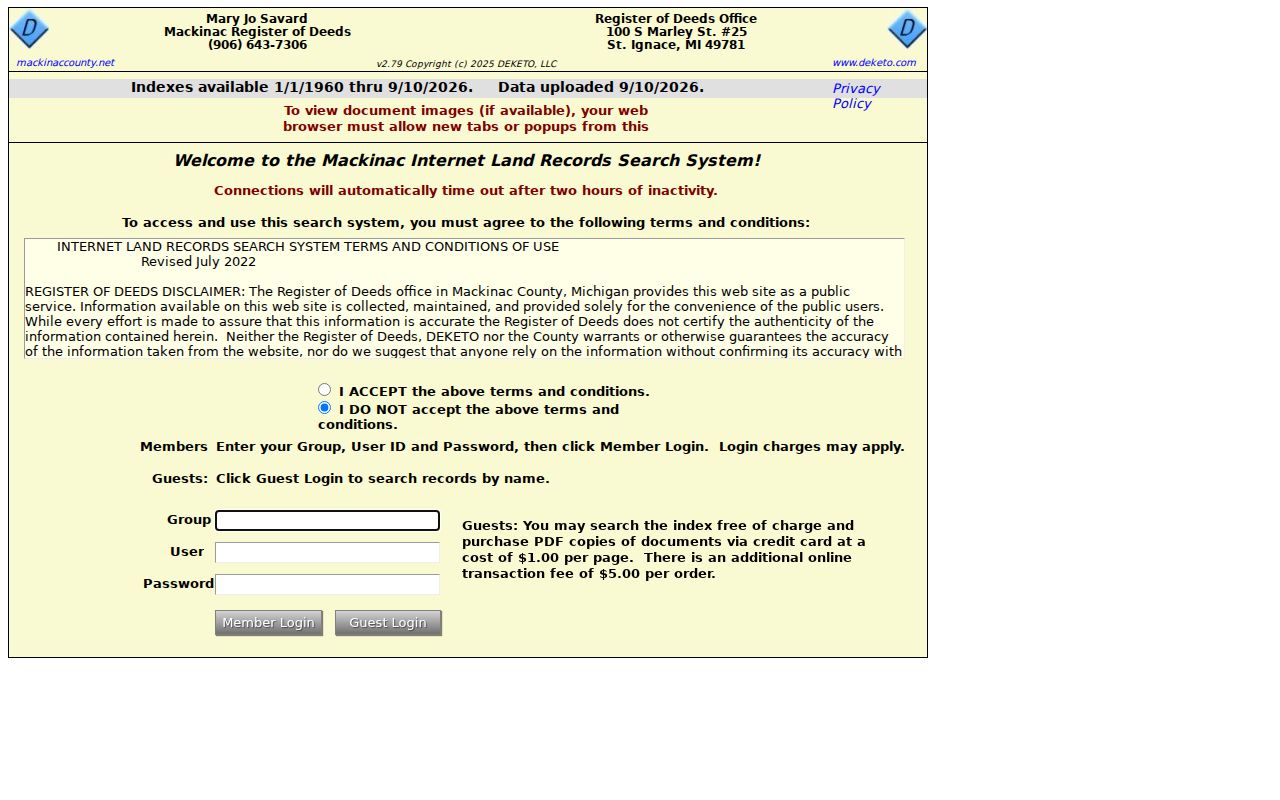
The gateway proves an index exists, not that every deed image or historical year is available online.
Records That Describe Mackinac County Land
No single document tells a property's whole story. Each of these Mackinac County property records captures a different legal, fiscal, geographic, or administrative fact about the land.
| Record | What it documents | Keeper | Access |
|---|---|---|---|
| Deed or land contract | A recorded conveyance or contract interest | Register of Deeds | LandWeb, copies, counter |
| Assessment roll | Classification and annual valuation fields | Local assessor and Equalization | BS&A link, notice, office |
| Tax account | Tax-year charges, payment, or delinquency | Local treasurer or County Treasurer | Tax portal and office |
| Parcel map | Mapped tax unit and reference layers | County GIS | Fetch, map purchase, data request |
| Plat | Recorded lots, blocks, and dedications | Register of Deeds | Index, deed books, archives |
| Court record | Litigation or an order affecting land | District, Circuit, or Probate Court | MiCOURT and clerk inquiry |
Permit and zoning files sit with municipal or state offices depending on jurisdiction. They supplement, but never replace, the deed, parcel, and tax records.
Four Mackinac Values Need Four Labels
Michigan assessment records use four distinct value labels. Assessed value, State Equalized Value, taxable value, and true cash or market value each mean something different. Assessed value multiplied by the equalization factor yields SEV. State guidance pegs SEV at roughly half of true cash value. Taxable value is where millage actually applies. Its capped-growth rules can push it far below SEV on property held for years. A transfer may uncap taxable value the following year, subject to statutory exceptions. Physical changes shift the math too. That is why a neighbor's nearly identical parcel can carry a very different taxable value. The Mackinac County tax-record guide sorts out annual values, exemptions, payment status, and appeals.
- Assessed value
- The assessor's valuation before equalization.
- SEV
- The equalized assessment figure.
- Taxable value
- The base used to compute property tax.
- Sale price
- A transaction fact, not the same measure as any assessment field.
Delinquent Taxes and Mackinac Auctions
The Mackinac County Treasurer connects BS&A delinquent-tax payment with Michigan's tax-sale portal. It also links the current parcel-auction page. All three are date-sensitive administrative sources. A delinquent balance can move after payment, redemption, foreclosure action, or correction. A parcel on an auction page is inventory for the moment, not a permanent fact. Start with the PIN and tax year. Then request a balance effective on a specific date. Ask what statutory event comes next. Buyers should pair the account with the deed index, legal description, map, and court record. Physical due diligence matters just as much. An auction listing guarantees nothing about access, condition, surveyed boundaries, environmental status, or clear title. Note: Record the date of every tax lookup. A printout reports one moment rather than a permanent status.
Property Fraud Alert Is an Early Signal
The Register of Deeds offers a Property Fraud Alert service tied to a name you choose. When a document linked to that name enters the recording system, you get notified. It does not block anything. It also proves no fraud. Pull the filing. Then contact the Register. A careful look at any alert compares the indexed instrument against what came before it.
Name matching has limits. A parcel held by a trust, an estate, or a business entity may be indexed under that legal name rather than a person's everyday name. The most reliable review matches the filing's parties, legal description, recording date, and instrument reference to prior Mackinac County property records. The official Register of Deeds page presents the office contact, document categories, and fraud-alert route.
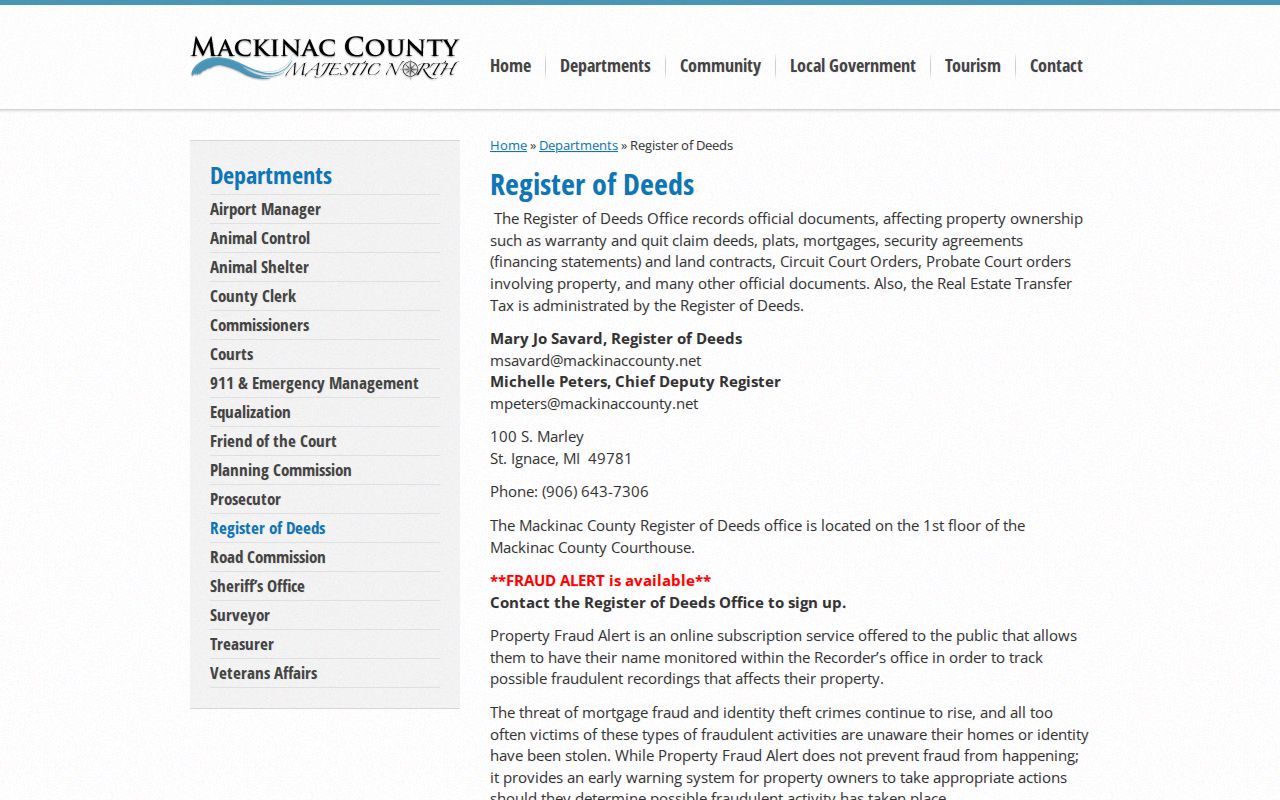
Use the contact information shown there to verify a concerning filing with the custodian.
St. Ignace and Mackinac Island Add City Layers
Mackinac County contains two incorporated cities. St. Ignace keeps local planning and zoning forms, and record questions there often trace to the Old Town, Marina Waterfront, Ferry Lane Corridor, and Railroad Recreation planning areas. Mackinac Island runs its own municipal assessor. The island maintains planning, zoning, historic-district, site-plan, and permit resources as well. Deeds are different. County recording still controls deeds for property in both cities.
A postal city name does not settle jurisdiction. Verify the mapped boundary and taxing unit, especially where a mailing label serves a township, an island, or an unincorporated place. For focused local context, see St. Ignace property records or Mackinac Island property records. Note: City permit files describe regulated work; they do not prove ownership or replace a recorded land instrument.
Older Mackinac Property Records Begin Offline
The oldest Mackinac County property records live offline. The Archives of Michigan county guides open a research trail far older than the online working index. Mackinac holdings include tax assessment lists from 1823 through 1826 and land-ownership material from 1850 through 1864. Deed holdings are cataloged for 1877, 1881, and 1899. Mortgage, tax-sale, and roll series add context. Those dates are not seamless coverage.
Mackinac was laid off in an 1818 territorial context, gained defined boundaries in 1843, and was organized in 1849. Older references may say Michilimackinac or use predecessor geography. The Library of Michigan adds county guides, newspapers, plat books, and local-history leads. Mackinac State Historic Parks holds island municipal microfilm, assessment rolls, and tax rolls, and each collection is best searched by its cataloged government unit and series rather than by modern address.
Offline Requests Fill Mackinac Portal Gaps
Online availability is not record existence. A document can exist in Mackinac County even when no portal displays it. The recorder publishes no earliest LandWeb year. Fetch states no fixed layer vintage. The county-linked BS&A page shows no field-level details. So when a portal falls short, call, visit, or mail the office holding the source.
Give the record type, parcel or legal description, party names, date range, and copy format. The Michigan Freedom of Information Act, MCL 15.231 et seq., offers another route to identifiable existing public records. A focused request saves search time and cost. FOIA does not force the county to create an analysis, answer a general question, or release material protected by law. For historic materials, an archive catalog or library reference desk may beat a broad public-record request.
Deeds, Maps, and Court Orders Answer Different Questions
A deed records a conveyance. A mortgage or lien records a claimed interest or security instrument, and a later release or satisfaction may clear it. A plat records a subdivision framework. A GIS layer depicts tax parcels for reference. A court or probate order may affect title and later appear in the recorder's files. Each thread leads to its own custodian.
The MiCOURT case search can surface public case numbers, types, status, judges, filing dates, and dispositions where permitted. Some case types and nonpublic information are excluded, and automated bulk collection is prohibited. Search party variants, then ask the appropriate Mackinac court clerk about the docket or order. Federal property litigation follows a separate PACER route.
Keep evidence in its proper lane. A map is not a survey, a tax bill is not a deed, and a public case result is not the complete court file.
What Mackinac County Property Records Establish
Official records answer many questions. They can identify a tax parcel, show the owner named on a roll, document recorded transfers, reveal assessed and taxable values, trace mortgages and releases, display reported building characteristics, and locate recorded plats or orders. Usefulness still varies. Date matters. Coverage, identity matching, and the limits of the underlying system shape what a record proves.
No GIS line establishes a surveyed boundary. A mailing address does not prove occupancy. An assessor name is never a title opinion, and no record guarantees every obligation has been released. Trusts, limited liability companies, estates, life estates, and same-name parties may require entity, probate, and deed review, while Michigan's Address Confidentiality Program and other laws may protect or redact information.
A records search is not a title search. Verify consequential findings with the custodian and obtain qualified help for title, survey, estate, easement, or boundary decisions.
Build a Dated Mackinac Parcel File
A parcel file earns its keep by showing how each conclusion was reached. Save the normalized address, PIN, taxing jurisdiction, and legal description. Keep the owner-name form, portal URL, search date, and instrument references beside them. Record negative searches as well, with every spelling and date variant you tried. For older work, cite the archive series. Add box or reel details, deed-book pages, and plat references.
Keep observed facts apart from interpretations. "Owner Address" is a label in the parcel-report design. It is not proof anyone lives there. A working-index entry proves an instrument was indexed. It does not replace reading the document itself. A tax-auction notice marks a dated stage of a process, not a guarantee of present availability. That discipline keeps Mackinac County property records reproducible. It holds up when a portal, assessment year, or delinquency status later shifts under your feet.
When results conflict, rank them by the question you are asking. The newest recorded instrument settles a conveyance. The responsible assessor's dated roll settles assessment status. The Treasurer's dated account settles delinquency, and a licensed survey settles a disputed boundary. Contacting the right custodian with a PIN, legal description, names, and a date range usually beats repeating a broad web search. It also builds a clear request a counter clerk can answer by phone, mail, or a focused Michigan FOIA submission.
Finish with a cross-check. Confirm that names, dates, parcel identifiers, and legal descriptions agree across every record you compared. When an online label is incomplete or ambiguous, keep the custodian's written response. Distinguish a verified fact from a mere lead. That habit stops a convenient search result from outweighing the official record. The county-linked BS&A property and tax destination is the official starting point for assessment searches.
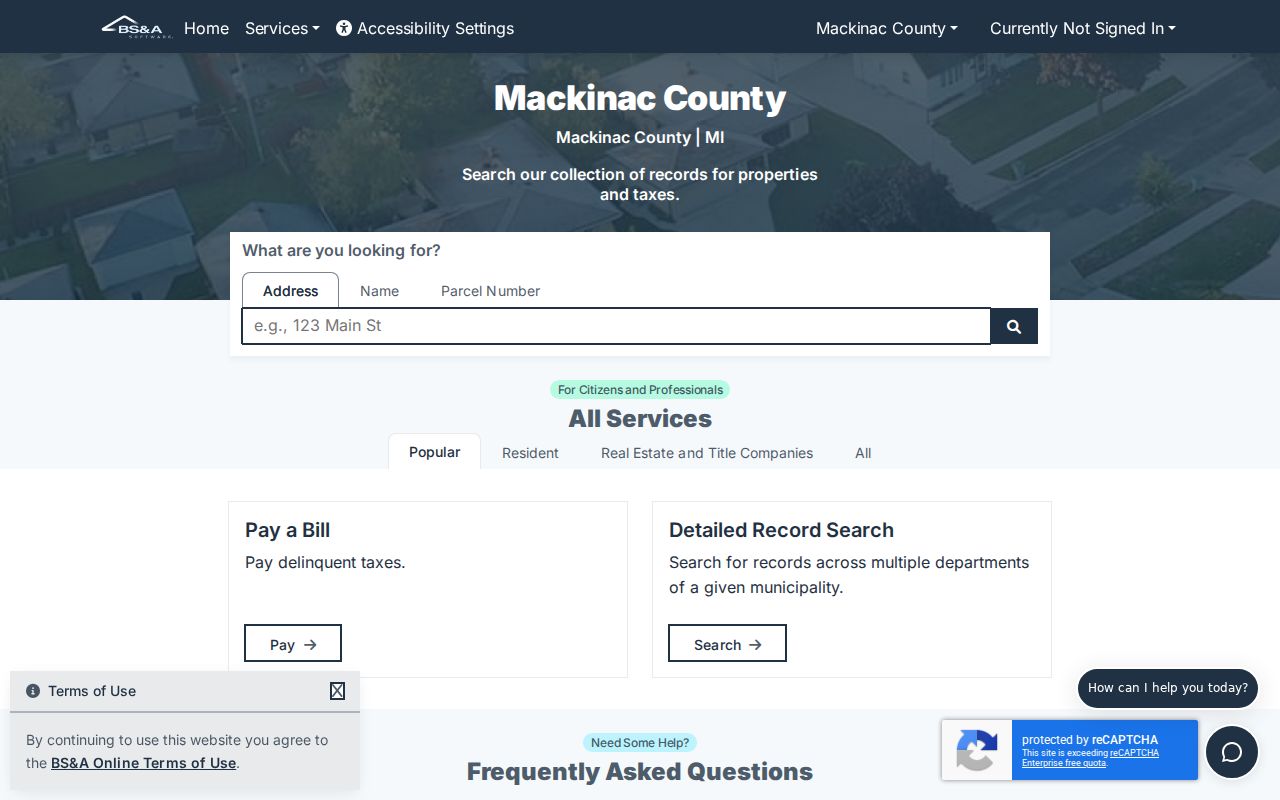
The county's official access page shows the route into the assessor's records. It is also a reminder to keep assessor and Equalization contact options handy whenever a live result will not open.