
Find Out Who Owns a Mackinac County Property
Mackinac County layers its ownership records across three systems. Fetch handles parcel discovery, BS&A carries the county-linked property and tax detail, and the Register of Deeds holds the recorded conveyance. Follow that order when starting from an address.
- Search the address in Fetch EUP and save the PIN, tax description, map location, and displayed owner or mailing fields.
- Compare the PIN with the county-linked BS&A property record and note its record date.
- Search the Register of Deeds LandWeb index for the apparent owner and legal-description clues.
- Read the newest conveyance and compare its grantee, recording date, and legal description with the parcel record.
- If an entity owns the parcel, use Michigan's official business registry to identify the entity record, without treating that record as proof of parcel ownership.
A fresh transfer can make the layers disagree. Mackinac County publishes no fixed lag for assessor roll updates, and the recorder indexes documents within about two working days. Report any conflict you find.
Mackinac County Assessment Records Give the First Owner Lead
The Equalization office connects the county's BS&A property and tax search with contacts for local assessors. Fetch offers several ways in. It accepts an owner name, a parcel number, or a street address, and its report shell carries an Owner Address label, a property-address field, tax descriptions, and assessment rows.
Read those fields carefully. A portal's field design shows what the system can display, but a blank field does not settle who owns a tract. Save the report date. Then contact the responsible local assessor when the ownership field is missing or a transfer is new.
The county-linked Mackinac County property and tax entry page may restrict unattended access. That limitation is posted by the county itself. Treat it as a sign-in prompt rather than a dead end.
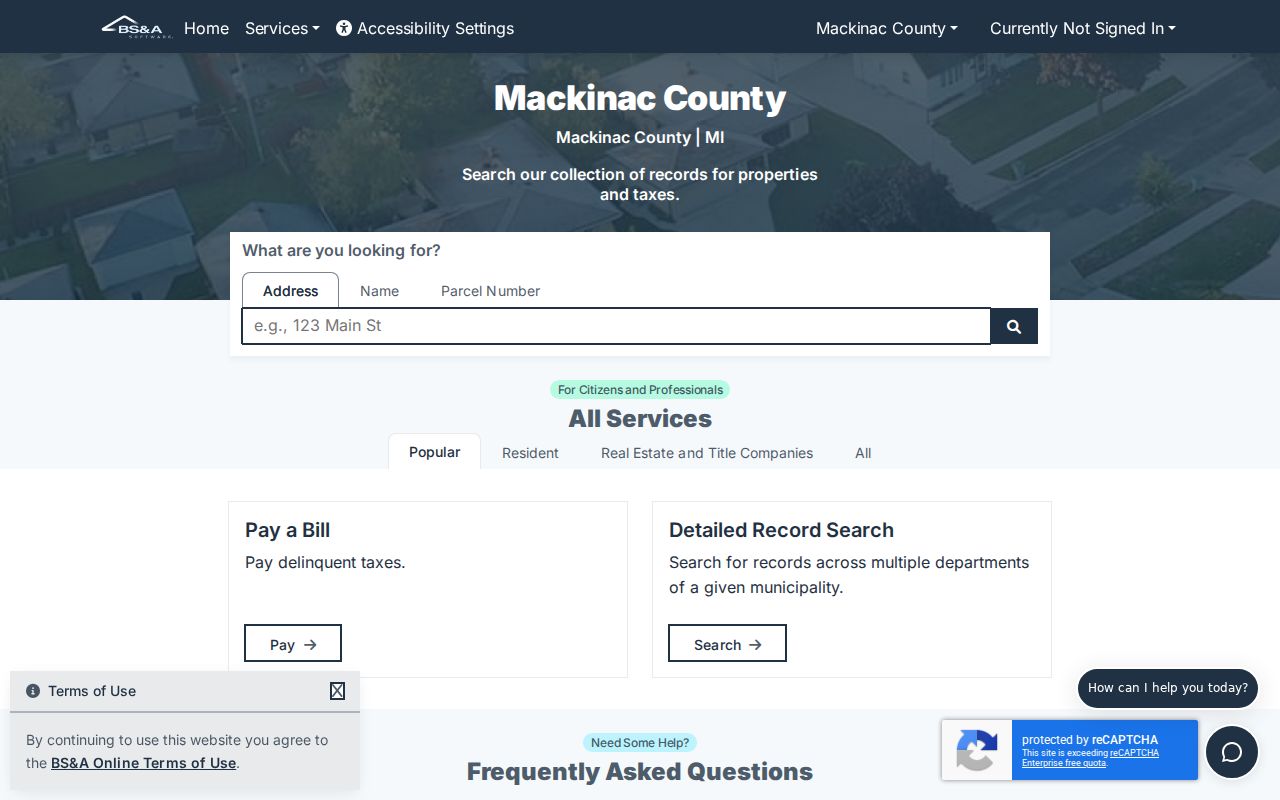
The page may not expose a parcel card. If so, pull the PIN from Fetch and ask Equalization or the responsible local assessor for the roll record.
- Owner of record
- The party shown on the applicable public roll at the time it was prepared.
- Situs address
- The physical location of the land or improvement.
- Mailing address
- The address used for owner notices, which may be elsewhere.
- Grantee
- The party receiving an interest in a recorded deed.
Where Mackinac County Property Owner Names Appear
No single screen answers every ownership question. Each official source captures a different piece of the relationship between a person, an entity, and the parcel.
| Source | Owner Info It Gives | Access |
|---|---|---|
| Assessment or tax roll | Current roll name and mailing address when available | BS&A link or local assessor |
| Register of Deeds index | Grantor, grantee, date, and description clues | Free working index; copies by request |
| Fetch GIS | Owner and mailing labels tied to mapped PIN | Public viewer and paid report options |
| Michigan business registry | Entity name, status, and filed roles | LARA corporations search |
A roll name never proves residency. It may point to a mailing address where the owner receives notices, far from the parcel itself. A business filing names an entity, not land.
The Latest Mackinac County Deed Confirms the Ownership Trail
The Register of Deeds keeps the recorded trail. Deeds, land contracts, court orders affecting land, mortgages, releases, and plats all pass through the office. The index searches name, description, or date. Run the apparent owner as grantee. Match the deed's description to the Fetch parcel. The county warns that the online index is edited and supplemented, may contain errors, and that a brand-new deed can still sit inside the normal indexing window. Get the actual instrument when a purchase, estate, easement, or possible fraud turns on the answer.
Owner lead, not title opinion. A matching roll name and deed grantee are strong research evidence, but exceptions, life estates, survivorship rights, or later court orders may affect title.
When a Mackinac County Owner Is an LLC, Trust, or Estate
An entity name is a valid lead. Search the deed under its exact wording. Punctuation and name variants count too. Michigan's business registry can distinguish a corporation or LLC and show filed roles, though it cannot prove the entity owns the parcel.
Trusts and estates work differently. Ownership may rest on the recorded conveyance, probate orders, or other instruments in the property trail. MiCOURT excludes some case types and is informational only. When a public portal falls short, the deed index and the court clerk still carry the record.
Note: Keep entity, trustee, personal-representative, and individual names separate so one role is never mistaken for another.
Mackinac County Property Fraud Alerts Protect a Name, Not Title
The Register of Deeds runs a Property Fraud Alert service. Enrollment happens by phone, with a name and an email. The county calls it an early-warning service. It says plainly that it does not prevent fraud. Alerts fire on matching names in the recording stream. It cannot judge whether the filing is valid. So the alert fits best after ownership is confirmed. Keep watching the official index and pull the instrument behind any unexpected alert.
Offline Routes Answer a Mackinac County Who-Owns Question
A portal is not the only route. The Register of Deeds answers index, search, and copy questions at 906-643-7306 or at the courthouse, 100 S. Marley Street in St. Ignace. Mailed copy requests are also accepted under the office's posted procedures.
Equalization links visitors to local assessors and treasurers, and it can identify which office holds the roll you need. When a record sits outside any portal, Michigan FOIA and the county's own request procedure offer a written channel. That route runs through exemptions, redactions, response rules, and fees.
Older ownership questions reach past the county's current files. The Archives of Michigan county guide and the Library of Michigan Mackinac guide hold land lists, deed references, tax rolls, plat books, and newspapers. Those sources add useful context. They still cannot replace the most recent recorded deed.
A written request earns a faster answer when it names the parcel, the custodian, the record type, and the date range. Ask Equalization or a local assessor for the assessment-roll entry tied to the PIN. Ask the Register of Deeds for the indexed instrument or copy tied to a recording reference. Neither office issues legal opinions. Keep each request specific.
Free index access differs from paid office work. The recorder's posted materials draw that line. The county prices ordinary copies at $1 per page, certification at $5 per document, and annual searches at $5 per name for each year searched. Confirm the current fee and delivery method before sending payment.
Resolve a Mackinac County Owner-Name Disagreement
Two different owner names usually point to timing, parcel selection, spelling, or record purpose. This is rarely a portal error. Start by confirming the address selected the right PIN, then compare each source's date. Then read the latest deed and its legal description closely. Leave life-estate, survivorship, trust, and court-order language untouched.
Rolls lag behind deeds. If the deed is newer than the roll, ask the assessor when the next update lands. If the index and the deed image conflict, contact the Register of Deeds. Mismatched legal descriptions are another matter. Stop and get title or survey help.
A sound answer names its source and access date. Saying the roll showed one name while a newer recorded conveyance named another beats quietly picking the result you prefer.
Limits on a Mackinac County Property Owner Lookup
Asking who owns this property settles very little on its own. Ownership does not prove occupancy. It may not show every ownership interest on the assessment roll. It does not guarantee that the owner can convey clear title. Michigan's Address Confidentiality Program can also change how protected information appears. Public records may be redacted or withheld under law.
Lawful use. Use Mackinac County owner information for land research, purchase diligence, estate work, or civic transparency. Never use it to stalk, harass, intimidate, or harm anyone.
Legal conclusions need more than a lookup. For the present-tense roll fields and the recent-sale gap, see the current property owner guide, and consult the official instruments plus a qualified title professional for any conclusion.