
Mackinac Deed Types and Uses
The Mackinac County Register of Deeds accepts any instrument that transfers land or affects an interest in it. Start from the kind of event you need.
| Deed type | What it does | Common use |
|---|---|---|
| Warranty deed | Conveys title with stated covenants | Sale transfer |
| Quitclaim deed | Conveys the grantor's interest without those covenants | Family or corrective transfer |
| Representative deed | Conveys through an authorized estate role | Estate administration |
| Land contract | Records contract rights in land | Installment transaction |
| Plat | Records lots, blocks, and dedications | Subdivision research |
Mackinac deed records reach beyond conveyances. Mortgages, financing statements, and orders from the Circuit and Probate courts all affect ownership or interests and join the same record.
Mackinac's Working Deed Index
Searches on the county's LandWeb index are free. Official guidance points to three paths: name, description, and recorded date. Copies can be bought by credit card. Most documents are indexed within two working days, though the Register calls LandWeb a working index that is edited and supplemented over time.
| Search field | Use | Caution |
|---|---|---|
| Name | Grantor, grantee, lender, or other party | Try variants and entity forms |
| Description | Lot, block, section, or other land text | Wording can change across deeds |
| Recorded date | Narrow a known transaction window | Recording may follow signing |
The Register publishes no firm start year for online images. A blank search result never proves that an instrument is missing.
Walk Mackinac's Grantor-Grantee Chain
A grantor gives up an interest. A grantee receives it, so trace Mackinac County deed records backward from the latest reliable owner, one conveyance at a time.
- Find the latest grantee by name and match the legal description.
- Read that deed for its grantor and recording reference.
- Search the grantor as an earlier grantee.
- Repeat while checking plats, court orders, and estate instruments.
- Log each date, party pair, deed type, and book/page or instrument reference.
One skipped deed can snap the chain. Try spelling variants and fragments of the legal description before deciding a gap truly exists.
- Grantor
- The party conveying an interest.
- Grantee
- The party receiving it.
- Chain of title
- The linked sequence of recorded transfers.
- Book and page
- A volume-based reference; newer systems may use an instrument number.
Copies of Mackinac Deed Records
Recording costs a flat $30. Copies run $1 per page, and certification adds $5. The Register's copy and search fee page also posts annual search and lien-search charges, and certification or staff research can raise the total. Confirm the current total before ordering. Online purchase is one route. The office also takes requests at 100 S. Marley Street, first floor, St. Ignace, MI 49781, or by phone at 906-643-7306. Include party names, an approximate date, the description, and any book, page, or instrument reference.
Recorded is not guaranteed. Recording gives public notice and a reference point, but the working index is not a title opinion and may contain errors.
Mackinac Recording Rules
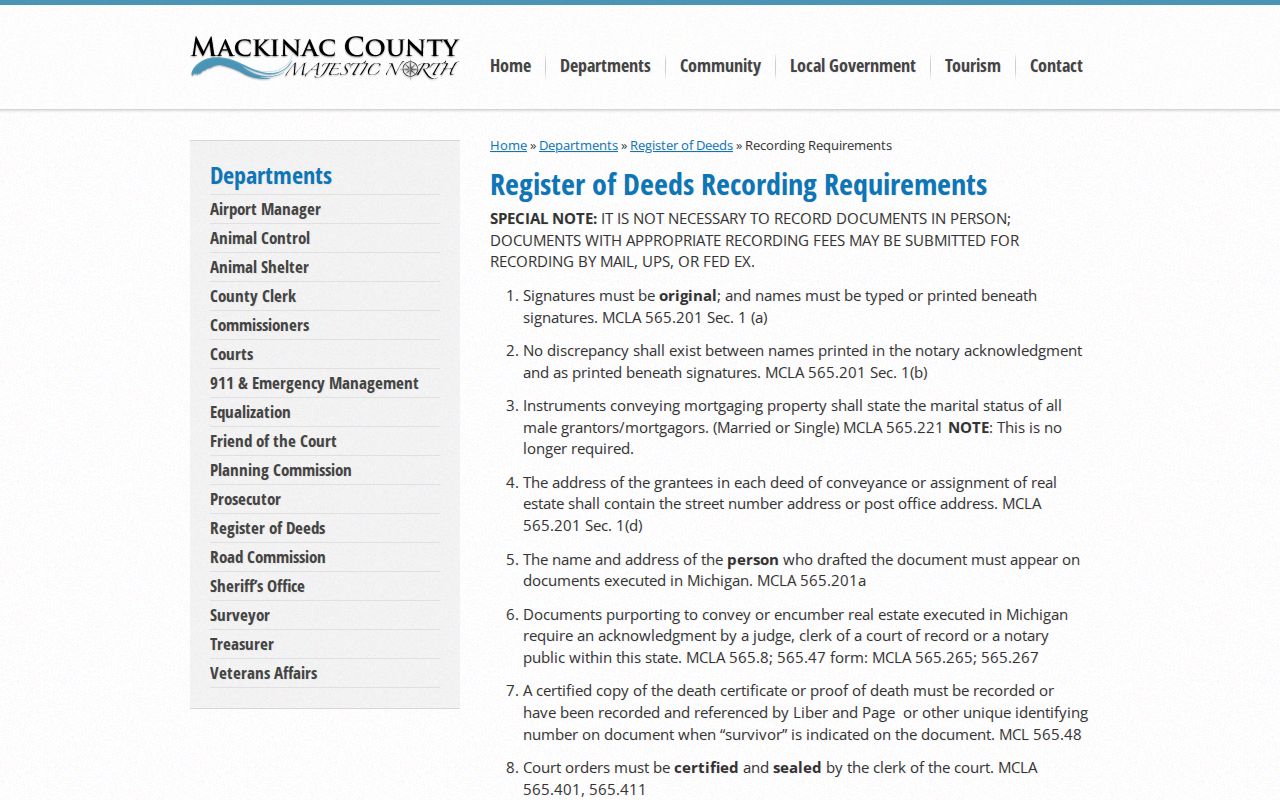
Every instrument must be legible. It must describe one recordable event. County guidance calls for original signatures, printed or typed names, the grantee's address, and the drafter's name and address. A valid acknowledgment is required too. Court orders must arrive certified and sealed. The first page needs a 2.5-inch top margin, with all other margins at one-half inch. Paper must be white, at least 20-pound stock, printed in black ink of at least 10-point type. Accepted sizes run from 8.5 by 11 through 8.5 by 14 inches. The first line states the recordable event. Only four sequential Social Security digits may appear. For a lot in a recorded plat, the plat caption and lot number may serve as the description, and survivorship transfers may need proof of death.
Liens Around Mackinac Deeds
A clean deed chain does not guarantee clean title. Mortgages ride alongside it, along with assignments, releases, land contracts, discharges, liens, satisfactions, easements, covenants, and recorded court orders. Match every item by party and legal description. Probate and Circuit Court orders can affect land and surface in the recorder later. MiCOURT offers public case information. It excludes some matters and is not a title search. A paid tax bill never replaces the deed trail. Note: A release should appear in the record; age or payment alone does not prove an indexed lien was cleared.
Early Mackinac Land Records
Online deed records stop at some point. The Archives of Michigan county guide picks up the trail. Its holdings list early tax assessments from 1823 through 1826. Land ownership material covers 1850 through 1864, and deed books come from 1877, 1881, and 1899. These are distinct series, so read them as separate holdings rather than seamless coverage. Older records may carry the name Michilimackinac. The county was laid off in 1818. It gained defined boundaries in 1843, and was organized in 1849. Use those terms for chains reaching that era. Deed books, plat books, assessment rolls, and tax-sale records can fill what LandWeb does not publish online. Mortgages, microfilm, and library material help too.
Keep Mackinac Deed Research Safe
The county promotes Property Fraud Alert. Enrollment brings notice of filings tied to a chosen name. An alert flags a filing for inspection. It is not proof of fraud and cannot block recording. Verify any concern with the Register. Mackinac County deed records serve lawful land research, purchase review, boundary and easement questions, estate work, and property history. Never use them to target a person. An attorney or title professional can weigh exceptions and documents a portal index never shows.
See the Mackinac Register Access Points
The official Register of Deeds page lists the courthouse office, document categories, the online index, fees, recording guidance, and Property Fraud Alert. Start there for direct requests. It works best when a LandWeb search leaves gaps.
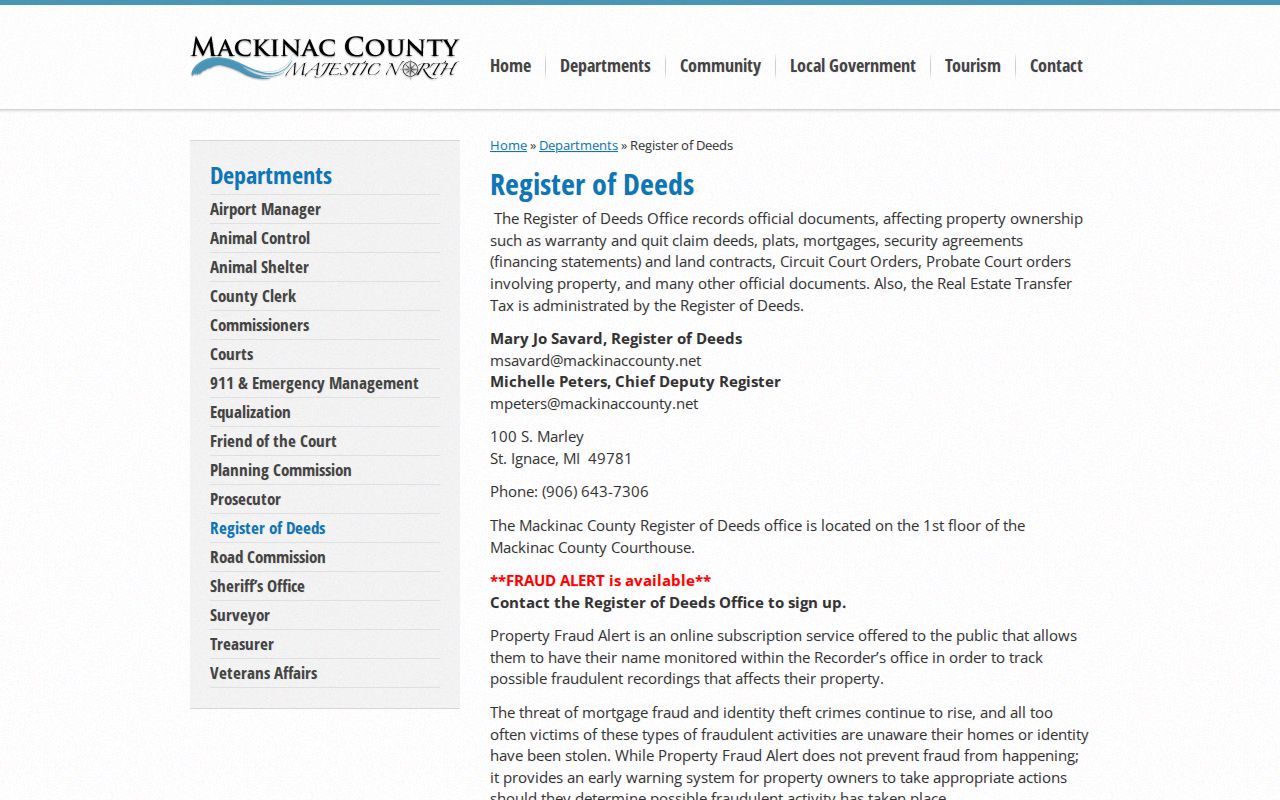
A deed search in Mackinac County does not live on one screen alone. The Register of Deeds also serves walk-in customers at 100 S. Marley Street in St. Ignace and answers the phone. Online records and counter service work together. The official recorder index supports searches by name, property description, and recorded date, exactly as the county describes.
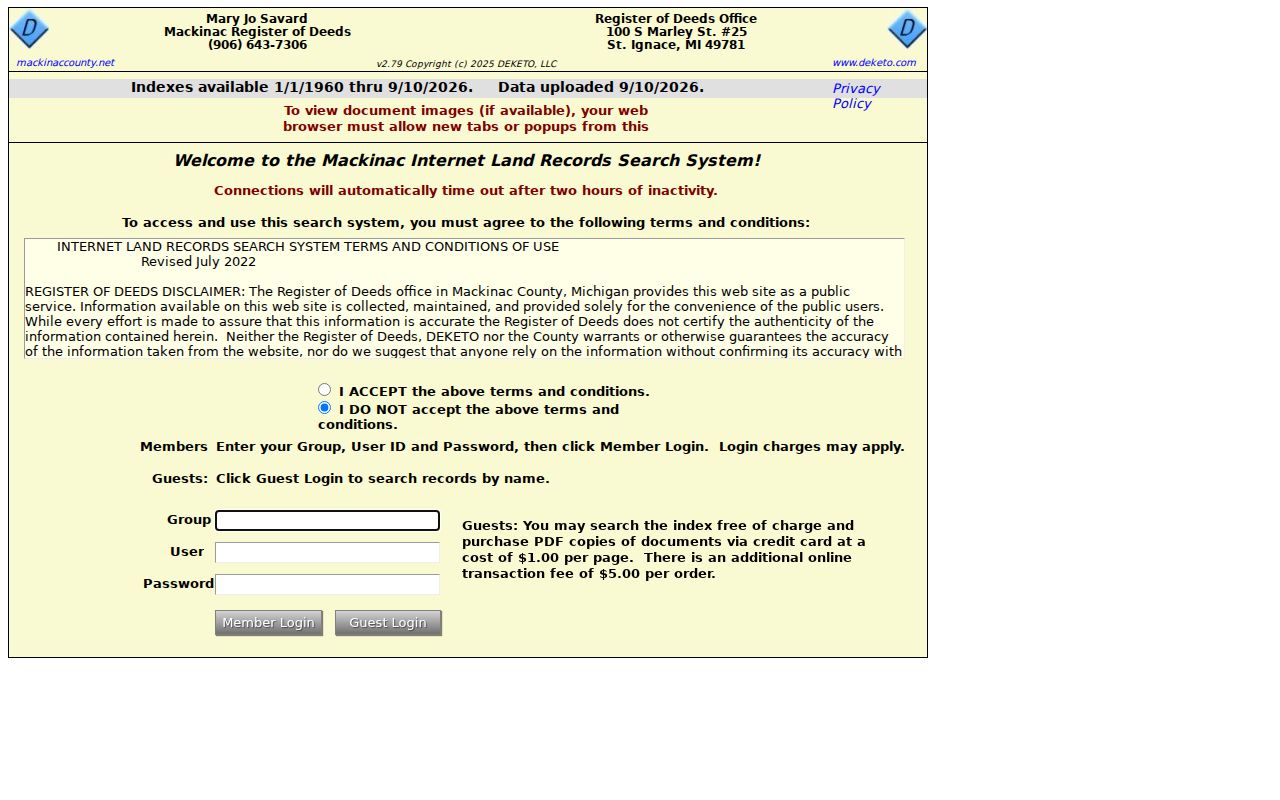
The index points you to instrument references. Get the recorded deed itself before treating it as legally controlling. That step keeps your property records work on solid ground.
Mackinac Deed Fees Depend on the Task
Recording, copies, certification, and staff searches are billed as distinct services in Mackinac County. The county lists a flat $30 fee to record an instrument. A copy runs $1 per page. Certification adds $5. For annual searches, the schedule charges $5 for the first year. It charges $3 for each year after that. State and federal lien searches carry their own fees. Transfer-tax certification and statutory exemptions can change what a deed filing costs. So confirm the current rule with the Register. The official statutory fee schedule posts the main recording and copy charges.
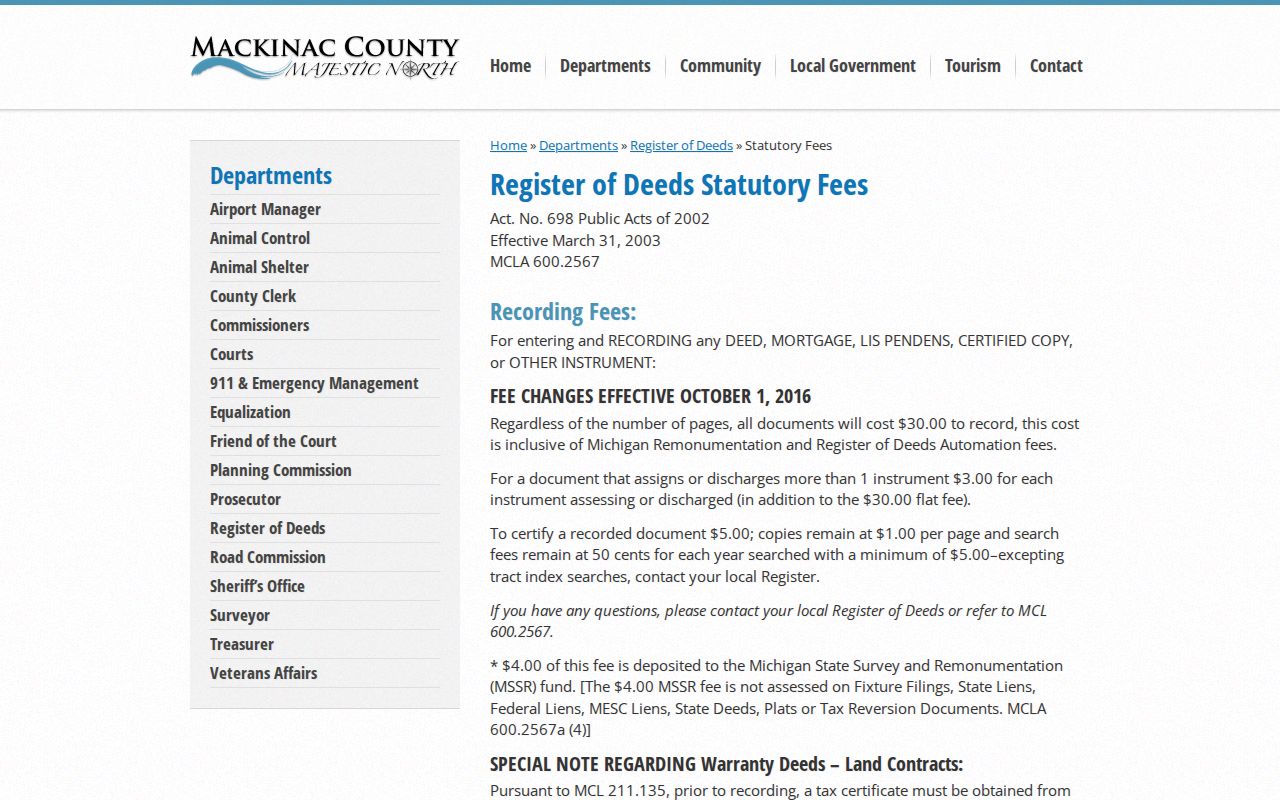
Match the fee to the exact service you request. Verify the total, accepted payment methods, and delivery options before mailing any deed records order. The separate copy and search schedule breaks certification apart from research charges.
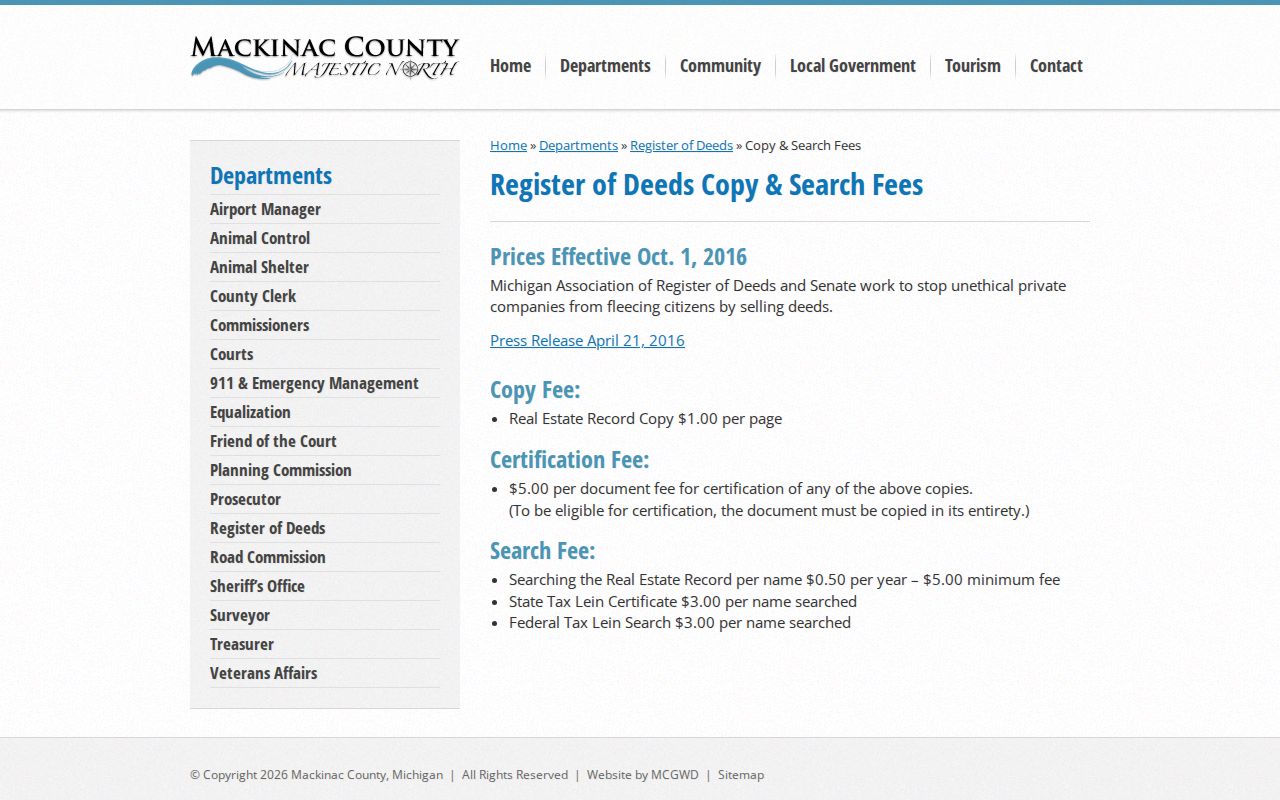
That split matters. A researcher holding an instrument number pays differently than one asking staff to comb a range of years in the deed records.
Why Mackinac Instruments Are Rejected
Mackinac County rejects instruments for a reason: recording rules protect readability and indexing. The first line must state the recordable event. Original signatures need printed or typed names beside them. The deed must also carry the grantee's address plus the drafter's name and address. Acknowledgments must be valid. Any court order submitted for recording must be certified and sealed. A land description is required. A plat caption with lot number often satisfies it for a recorded lot. Formatting is just as strict. The county wants a 2.5-inch top margin on the first page and one-half-inch margins elsewhere. Black ink, at least 10-point type, and white paper from 8.5 by 11 up to 8.5 by 14 inches are required. These standards round out the recording-requirements summary.
A rejected instrument delays the public index. Check formatting and execution first, whether you file by mail, at the counter, or through an approved e-recording provider.
Follow Releases Alongside Mackinac Deeds
Chain research in Mackinac County property records should track interests being cleared as carefully as interests being created. Pair each mortgage with its satisfaction or release. Match an assignment to any later transfer. Match a land contract to its discharge or deed. A lien needs a recorded release or a court disposition. Easements and covenants can survive ownership changes unless a later instrument amends or ends them. Never assume an old mortgage vanished just because years passed. The tax bill showing paid is not enough. Search the borrower, the lender, their successors, the legal description, and the relevant date range. Court and probate orders can also break a simple grantor-to-grantee chain. Public MiCOURT results and the underlying clerk file may reveal the missing event in the deed records.