
Read the Mackinac County Owner-of-Record Card
Equalization posts the BS&A property and tax search alongside Fetch, which serves up searchable parcel reports. Fetch labels its fields clearly: owner mailing address, property address, assessment rows, acreage, tax description, sales history, and tax history. Field display varies by parcel, so confirm what appears for the one you select.
| Owner or owner address | Current roll lead when populated; exact local label was not verified |
|---|---|
| Mailing address | Where assessment or tax correspondence is sent |
| Property address | The situs tied to the selected PIN |
| Tax description | Short parcel description used for identification |
| Sales information | Transfer context, subject to source and date checks |
| Assessment rows | MBOR Assessed, Final SEV, and Final Taxable labels by year |
An owner of record is not an occupant. The tax roll may carry a mailing address far from Mackinac County because notices go wherever the owner wants them. Treat it as a contact clue only, not proof of where anyone lives.
Start the Mackinac County Current Owner Check at Equalization
The Mackinac County Equalization office anchors any current owner check. Its page gathers annual reports, BS&A instructions, and the property and tax link. It also lists local assessor and treasurer contacts, plat books, and land-division material. It is a navigation hub, though, not one countywide assessor database. The responsible assessor depends on the local unit. That structure matters when something looks off. If the portal omits an owner, shows a stale mailing address, or flags an unexplained transfer, work from the local-assessor list. You can also call Equalization at 906-643-7310. The office sits in Room 120 of the courthouse. It generally lists hours of 8:30 a.m. to 4:30 p.m. Note: Ask which roll date the displayed owner reflects. Compare it with a later-recorded deed. The county-linked entry point may also limit unattended access. This view of the Mackinac County BS&A route shows why a phone or office visit remains a practical fallback.
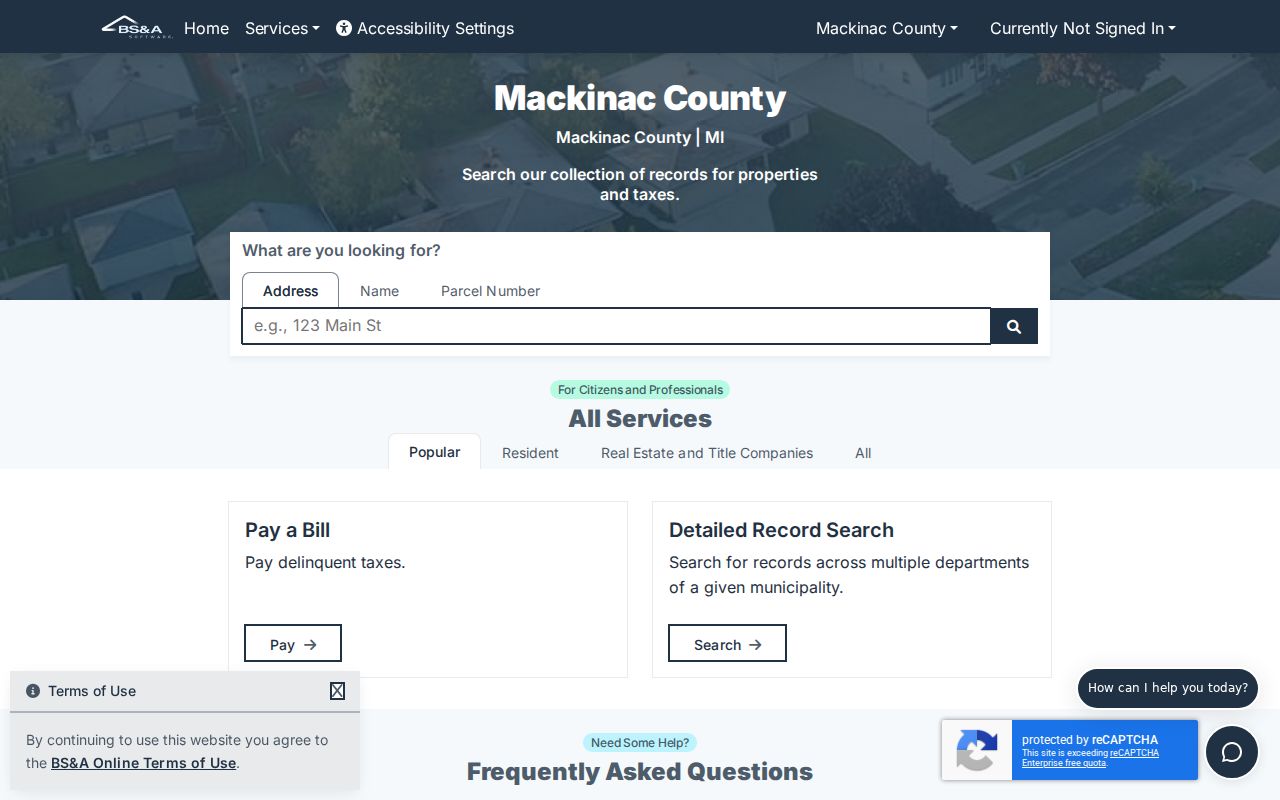
A restricted landing page tells you nothing about a parcel. Take the PIN to Fetch or the local assessor instead of filling in owner fields by inference.
Reach the Mackinac County Current Owner Sources Offscreen
The portals cannot settle every current-owner question. Go instead to the offices that keep the layers. Equalization sits at 100 S. Marley Street, Room 120, St. Ignace, and lists 906-643-7310. The Register of Deeds occupies the same courthouse complex and lists 906-643-7306. The recorder takes questions about its working index and copy procedures.
For records outside the portals, a focused Michigan FOIA request works well. Name the record, the date range, the parcel number, and the delivery format you want. Exemptions and fees may apply. Ask for an existing document. Staff cannot be asked to decide who legally owns a parcel.
Some disputes go deeper than records. A deed's legal effect, a life estate, a survivorship clause, or a court order may be at issue. Obtain the instrument and seek qualified title advice. Custodians provide records, not legal opinions.
Mail requests should keep the return address, parcel or legal description, copy type, and payment instructions confirmed with the office. For time-sensitive work, call first. Ask whether the record is online, at the counter, by mail, or through a paid office search.
Document the Mackinac County Current Owner Finding
A reproducible owner check writes things down. Record the PIN, the situs address, and the owner wording. Add the mailing field, the source name, and the access date. Save the latest deed reference too, and note whether the legal description matched the parcel. That compact record keeps a later portal refresh from erasing your basis. When a field is missing, label it unavailable. When a trustee or entity is named, preserve the exact role. A newer deed and an older roll may disagree. In that case, state both dates and route the discrepancy to the custodian. These habits keep the finding factual without turning it into a title conclusion.
Mackinac County Owner Mail May Point Somewhere Else
Fetch keeps an owner-address label separate from the property address. The mailing address supports notice delivery. The situs address locates the parcel. Seasonal property, entity ownership, estate administration, and other lawful arrangements can split those addresses without any records error.
- Owner of record
- The party carried on the applicable public roll.
- Assessment roll
- The official listing used in property assessment administration.
- Situs
- The physical location assigned to the property.
- Recording lag
- The period between a conveyance and its appearance in another public system.
Use the tax mailing field for property correspondence only. It is not evidence of residence or occupancy.
Confirm the Current Mackinac County Owner by Deed
Assessor-linked sources give the fast lead. The Register of Deeds holds the recorded deed that actually conveyed the interest. Compare the same parcel, not a similar name or street.
- Search Fetch EUP by address, owner, or PIN and save the displayed identifiers and report date.
- Use the LandWeb working index to search the apparent owner and legal-description clues.
- Identify the newest relevant deed or other conveyance and read its grantee, date, instrument type, and legal description.
- Compare that instrument with the roll and contact the assessor or Register of Deeds if they disagree.
- Vesting
- The manner in which the recorded instrument places an interest in a grantee.
- Registered agent
- A filed contact for a Michigan entity, not automatic proof of who controls land.
Recent-sale gap. Mackinac County publishes no fixed roll-update lag. For a just-recorded transfer, the newest deed is stronger evidence of the conveyance than an older parcel display.
Mackinac County Recording Time Sets a Practical Currency Check
The Register of Deeds states that documents are generally indexed within two working days. They are available after that. It also describes LandWeb as a working index. It is constantly edited and supplemented. It may contain errors. Those two facts frame a current-owner search. Check the recording date. Just do not treat the index as a guaranteed title report. If a closing happened days ago, ask the recorder whether the instrument has entered the index. Then ask the assessor which roll date is online. Keep the answer and access date with your search notes.
Verify Entity Names on Mackinac County Owner Records
An owner of record on a Mackinac County parcel is not always a person. Sometimes the deed names an LLC or a corporation. Run the exact entity name through the Michigan LARA corporations route. This pulls the business filing. That record helps separate lookalike entities and lists the roles each one filed. It cannot prove the entity holds this particular parcel, though. The deed itself supplies that link. Return to the deed records whenever the connection matters.
Trusts and estates raise a similar caution. A Mackinac County deed may show a trustee. It may also show a personal representative, a probate order, or some other capacity. Record each role exactly as written. Never swap the recorded grantee for a person guessed from a different source. The owner of record is whoever the deed says it is.
Current Mackinac County Owners Can Enroll for Record Alerts
Mackinac County's Register of Deeds runs a Property Fraud Alert service. Call the office to enroll with a name and an email. The service sends an early warning. It fires whenever that name shows up in recording activity at the deed office. It monitors names only. The county states plainly that it does not prevent fraud.
Treat any unexpected alert as a starting point, not a conclusion. Pull the newly recorded instrument itself and read it. An alert tracks a name only. The deed and its legal description are what tie a document to a Mackinac County parcel.
Use Mackinac County Current Owner Data Lawfully
A tax roll mailing address is a public way to send a letter about land. Michigan law still allows protected details to be redacted from the record. The Michigan Address Confidentiality Program gives eligible participants a designated-address structure for exactly this reason. A tax bill address is a public record. No one should use it to work around that protection.
Lawful use. Contact a Mackinac County current owner only for legitimate property matters. Do not use a name or address to stalk, harass, intimidate, or harm anyone.
A current-owner card only shows the present tense. To trace the earlier chain of grantors and grantees on a Mackinac County parcel, use the former property owners guide.