
Build a Mackinac County Former-Owner Timeline
Every solid timeline works in reverse. Take the most recent recorded conveyance you can confirm, then treat its grantor as the next lead in the property search. Mackinac County publishes no verified earliest year for its online index, so the sequence of sources below reflects how the records are layered rather than a promise that every era is digitized.
| Source | Years It Covers | Where Held | What It Shows |
|---|---|---|---|
| Newest transfer | Grantor to current grantee | Deed or other conveyance | Instrument number or book/page |
| Prior transfer | Earlier owner to later grantor | Warranty, quitclaim, land contract, or court order | Exact legal description |
| Online trail ends | Last indexed predecessor | Recorder contact and older books | Confirmed cutoff, not assumed first deed |
| Archive trail | Historic owner or taxpayer | Deed, assessment, tax, mortgage, or plat series | Series, box, volume, and year |
Recent chains begin with the LandWeb working index. For nineteenth- and early twentieth-century owner of record questions, the State Archives guide helps you target a named series before you contact the repository.
Mackinac County's Working Index Starts the Backward Search
The Register of Deeds offers a free index searchable by party name, description, and recorded date. Most documents land in the index within two working days. The county cautions, though, that staff constantly edit and supplement the index. Errors do appear. So search surname variants. Then narrow the results with land-description and date clues from the parcel.
| Search key | What it contributes | Historical caution |
|---|---|---|
| Party name | Grantor and grantee leads | Spelling and entity styles can change |
| Description | Connects transfers to the same land | Tax descriptions may be abbreviated |
| Recorded date | Orders likely transfers | Recording can follow execution |
Pull the instrument reference and the full legal description from each actual deed you retrieve. Resist the urge to add someone to the timeline just because a surname matches on the same road. The deed, not proximity, must connect them to the parcel. Note: The county does not state the oldest online instrument or the range of digitized images. The official Mackinac County recorder index page displays the name, description, and date entry points. Use it to begin the working index.
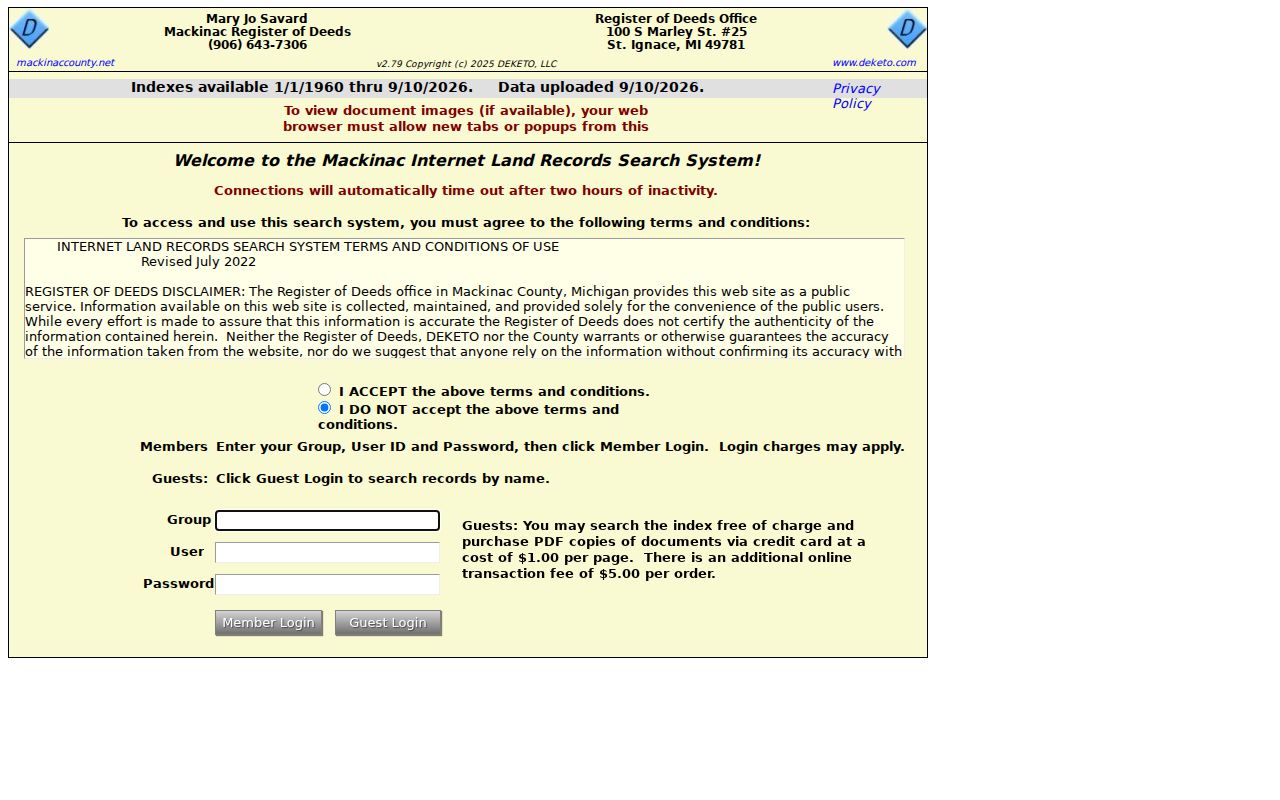
An unpopulated deed result still has value here. It points you toward the right search route without claiming anything about a specific former owner of record.
Request Older Mackinac County Ownership Material by Office or Mail
Older ownership material in Mackinac County usually starts with the Register of Deeds. Call the office at 906-643-7306 with what you already know. A last known party gives staff a place to begin. A legal description, instrument reference, and year help too. Ask what comes next in the chain. The answer may be an older deed book. It could also be microfilm, a paid annual search, or an archival series. Mail and courier deliveries are accepted at 100 S. Marley Street in St. Ignace.
For archival requests, keep it narrow. Give Archives staff the county-guide series. Give them a date rather than a broad sweep of one surname. The Library of Michigan and Mackinac State Historic Parks can also help. Their collections cover plats, newspapers, municipal microfilm, and tax context for the county.
Michigan FOIA is another route to a non-portal county record. Exemptions and fees still apply. The law does not force an office to build a title chain. It does not have to interpret ownership or answer a legal question.
Walk the Mackinac County Deed Chain in Reverse
Read each deed as a bridge between two points in time. The grantee received the interest. The grantor conveyed it away. Now search for the earlier deed where that same grantor appeared as grantee, and repeat until the parcel's chain resolves.
- Confirm the latest deed, its grantee, legal description, instrument type, and recording reference.
- Record the grantor exactly and search that name as an earlier grantee.
- Match the next instrument by legal description and recording context, then repeat.
- Check mortgages, releases, assignments, court orders, land contracts, and plats at each stage.
- When the online results stop, ask the recorder about older books or a paid search and move to archival series.
- Grantor and grantee
- The conveying and receiving parties named in an instrument.
- Chain of title
- The linked sequence of instruments affecting an interest in land.
- Reverse index
- A party index organized to help trace names in the opposite transaction role.
- Warranty and quitclaim deeds
- Different deed forms whose legal effect must be read from the actual instrument.
Archives Extend Mackinac County Previous-Owner Research
The Archives of Michigan county guide opens doors that an ordinary web property search cannot. It documents a land-ownership series covering 1850 through 1864. It also covers selected deed holdings from 1877, 1881, and 1899. Patents and deeds from 1879 through 1881 appear there, and so do several years of quitclaims and mortgage material. The same guide lists assessment rolls from 1858 through 1898. It lists early tax assessment lists from 1823 through 1826. It also covers land sold for delinquent taxes from 1856 through 1871. These sources can bridge gaps or test a name. A taxpayer entry alone, however, does not prove title. Request the series, box, volume, microfilm, and access conditions before you visit or order. The guide is an inventory clue. It is not a promise that every record is digitized or ready onsite.
Plat Books and Newspapers Help Reconnect Mackinac County Parcels
The Library of Michigan Mackinac guide lists county histories, newspapers with uneven date coverage, a 1959 road map, and Rockford plat books or atlases. Those plat books or atlases cover many years from 1965 through 2006. Plats can preserve lot identity when road names or parcel numbers change. Newspapers may supply tax-sale, estate, or land-notice context. Treat these sources as lead generators. Then verify each lead in a deed, assessment roll, tax file, or court order. A name printed beside a tract in an atlas reflects that publication's method and date. It is not every legal interest in the parcel.
Mackinac Island Records Add a Distinct Historical Layer
Mackinac State Historic Parks holds microfilm copies. These cover City of Mackinac Island records from 1817 through 1939. The collections also include assessment rolls from 1889 through 1920. Tax rolls run from 1900 through 1939. County tax records date from 1884 through 1888. Together they add municipal and tax context to an island chain. The Parks page states plainly that it holds no vital records. It cannot replace the Register of Deeds for the legally operative deed records. Still, it helps distinguish historic island parcels. It also clarifies name variants and municipal records outside the current web index. Note: Keep the jurisdiction and date clear, because Mackinac Island municipal records and Mackinac County recording records answer different questions.
Probate and Tax Sales Can Break a Neat Mackinac County Chain
A tidy chain of sale deeds is rare in Mackinac County. Probate orders, circuit-court decrees, land contracts, tax-sale records, quitclaims, mortgages, and releases can all appear. Each one transfers or affects ownership. Any of these can explain a gap in the deed records. An unexpected owner of record can be explained the same way. Run the same parcel description and party names across every document type first. Only then call the chain broken.
MiCOURT leaves out some case types. That means a missing online case proves nothing about the court file itself. The Register of Deeds holds the recorded instruments. The right court clerk keeps the underlying order. Either office is the better follow-up for a property-specific question.
How Far Back Mackinac County Ownership Records Reach
How far back you can trace ownership depends on the source. Mackinac County began as Michilimackinac in 1818. It gained defined boundaries in 1843. It organized in 1849, and archival tax lists and land material reach into parts of the nineteenth century. The oldest instrument you can actually search online varies by deed records source. Plan on working backward from the most recent deed.
No assumed cutoff. Do not call the first LandWeb hit the first deed. Confirm the online limit with the Register of Deeds, then continue in deed books and the Archives guide.
A Mackinac County chain of title does not always move by sale deed alone. Probate orders can transfer a parcel after an owner dies. Circuit-court orders, land contracts, quitclaims, mortgages, and releases each leave their own paper trail. Tax-sale records explain some of the strangest gaps. Before calling a chain broken, run the same parcel description and party names through every one of those deed record types. Do it at the recorder's office.
Lawful use. Trace Mackinac County former owners for house history, estate work, title research, and property diligence. Never use the trail to track, harass, or harm a living person.
To order and read a single recorded instrument, see the Mackinac County deed records guide. For a definitive title conclusion, rely on a qualified title professional.