
Mackinac Tax Record Fields
No single office holds everything. Mackinac County property tax records are spread across the local assessor, county Equalization, and the Treasurer. Read each label and tax year before comparing any two numbers.
| Field | What it shows | Where to verify |
|---|---|---|
| Assessed value | One-half of true cash value under Michigan's framework | Local assessor and notice |
| State equalized value | Assessed value after equalization | Assessment roll or notice |
| Taxable value | Value used with millage to calculate tax | Tax record and notice |
| Exemption status | PRE or another applied status | Assessor |
| Payment or delinquency | Time-sensitive account status | Treasurer and BS&A |
Remember that a tax bill is not a deed. It may name a taxpayer or mailing contact without proving who holds title today.
Look Up Mackinac Property Tax
Start with the Mackinac County Equalization page. It links the county's BS&A property and tax search. Enter an address or parcel number where the interface allows. Pick the right tax year. Save the parcel identifier with every result. The county publishes no documented list of search modes beyond that official link. Rely on what the BS&A screen itself offers.
- Identify the parcel in Fetch or the county-linked tax system.
- Match address, tax description, and PIN.
- Record assessed, SEV, taxable, exemption, and tax-year fields.
- Check current payment or delinquency with the Treasurer.
- Contact the assessor when classification, value, or exemption is disputed.
Mackinac County Equalization works out of Room 120 at 100 S. Marley Street in St. Ignace. The office takes calls at 906-643-7310 and lists its hours as 8:30 a.m. to 4:30 p.m.
Mackinac Values Are Not Interchangeable
Three values do three different jobs. Michigan guidance places assessed value at roughly half of true cash value, while SEV reflects equalization across jurisdictions. Taxable value is the base that millage actually applies to, and its growth can diverge from market movement. Treat the numbers as linked but never interchangeable.
- True cash value
- Michigan's term for usual selling price under the statutory standard.
- Assessed value
- The assessor's valuation before equalization.
- SEV
- The value after county and state equalization.
- Taxable value
- The value to which tax rates are applied.
- Uncapping
- A taxable-value reset that may follow a transfer, subject to law and exceptions.
A listed value is not a private appraisal or a promise of sale price.
Mackinac Exemptions and Classifications
An exemption changes how land is taxed, not who owns it. Michigan offers several common routes. These include the Principal Residence Exemption, qualified agricultural property, qualified forest property, and the poverty exemption. Each carries its own facts, forms, deadlines, and review path.
Your city or township assessor stays the key contact for notices, classifications, exemptions, and Board of Review matters. County Equalization coordinates the assessment work. It also publishes assessor and treasurer contacts. Keep filed forms and decisions tied to their tax year. An exemption granted in one year settles nothing for the next.
Note: An exemption is a tax status, not a deed restriction or proof of title.
Appeal a Mackinac Assessment
Start with the assessment notice itself. Michigan notices list prior and current taxable value, assessed value, SEV, classification, transfer status, and appeal details. Compare the parcel's characteristics and classification against the actual property before disputing any value.
- Contact the local assessor to correct factual errors and learn the local meeting schedule.
- File with the local Board of Review when that is the required first step.
- Keep the notice, photos, sales evidence, sketches, and written decision.
- Use the Michigan Tax Tribunal route and deadline that applies to the property class and issue.
Deadlines control. Board of Review and tribunal timing can bar an appeal; confirm the current calendar with the assessor rather than relying on an old notice.
Mackinac Delinquent Tax Channels
Unpaid real-property tax in Mackinac County flows through the Treasurer. The Treasurer also runs the foreclosure and auction functions under Michigan's PA 123 framework. The county links a delinquent-tax payment search, tax-sale.info, and its own auction-parcel page. Payment, redemption, court action, or a later filing can all change a parcel's status. Always confirm dates before drawing conclusions.
The Treasurer's office sits in Room 30 at 100 S. Marley Street in St. Ignace. Call 906-643-7318 during listed hours of 8:30 a.m. to 4:30 p.m. When you ask about a parcel, be specific. Request the tax year, the balance date, the parcel number, and the next statutory event. A delinquent label alone does not prove foreclosure is complete.
The county auction page posts current notices. Treat it as a fresh announcement board, not a standing inventory of land still available.
Mackinac Tax Sales Need Context
An auction listing settles very little. The parcel may carry occupancy, condition, access, boundary, environmental, or title problems. The listing never mentions them. Match the PIN in Fetch and read the legal description. Search deed records and recorded notices, and check any court action before concluding anything.
Historic research runs on a separate track. The Archives of Michigan county guide points to early tax assessment lists from 1823 through 1826. It also notes later tax-sale material and assessment holdings. Those sources illuminate ownership and land use over time, but they report no current balance.
When Mackinac Tax Search Fails
When BS&A is down, use Fetch instead. It supplies the PIN and tax description. Then call the right Mackinac County office for the field you need, whether that is the local assessor, Equalization, or the Treasurer. Ask for a dated record, not a verbal estimate. A purchase, appeal, estate, or payment dispute may ride on the answer.
A written Michigan Freedom of Information Act request can describe an existing record. That covers assessments, taxes, and administrative files that offices do not routinely post. The general response period is five business days. Extensions are possible. FOIA does not force an office to build a new calculation. It will not answer a research question for you either.
Keep the record layers separate. Mackinac County property tax records show tax administration; recorded deeds establish conveyances, and GIS lines remain informational rather than surveyed boundaries.
County and Local Assessors Split the Work
Mackinac County Equalization builds countywide reports. It also coordinates assessment administration, and publishes contacts for city and township assessors and treasurers. The local assessor handles classification, characteristics, and exemption status. That office also manages assessment notices and Board of Review procedure first. Once real-property taxes turn delinquent, the county Treasurer takes center stage. The Equalization office page gathers those routes together. It adds annual reports, land-division information, and the county-linked property search.
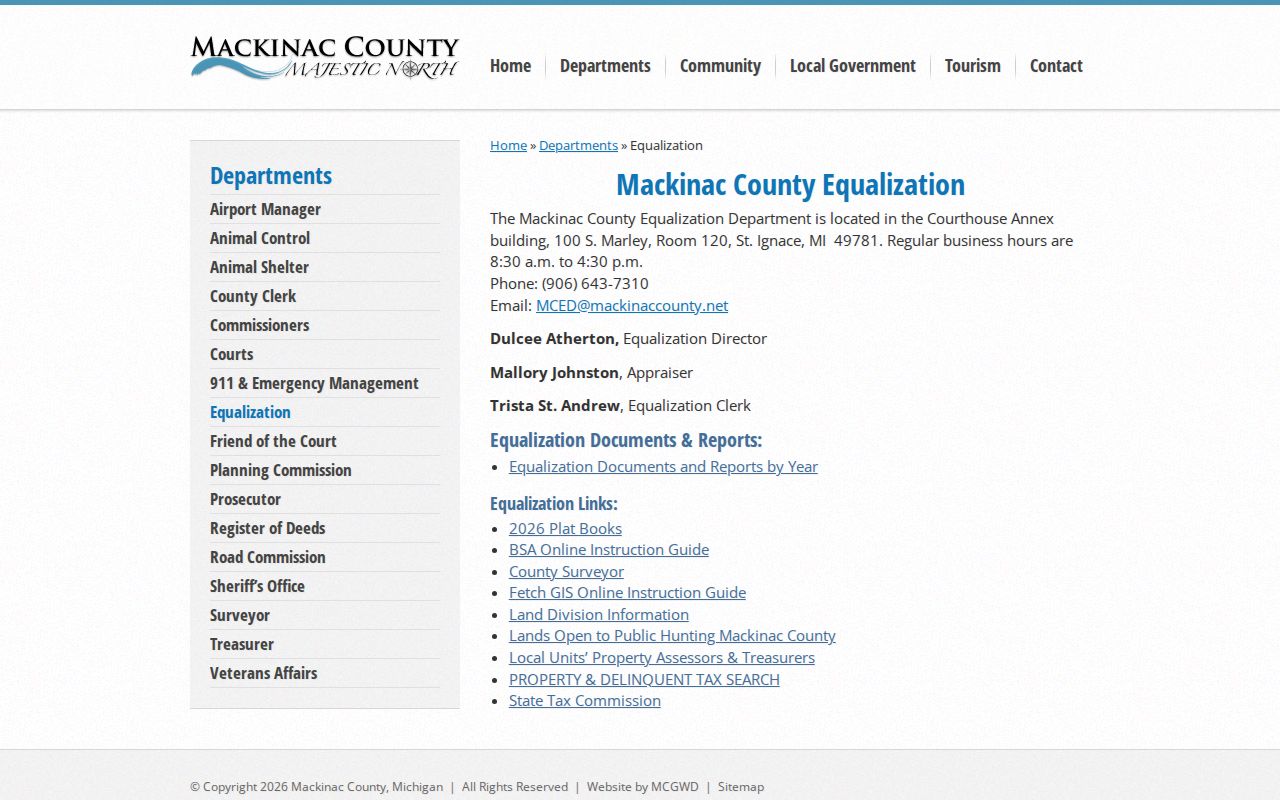
The published contact list routes questions to the assessor for the actual taxing unit. That beats relying on the postal city alone.
BS&A Is a Mackinac Starting Point, Not the Whole File
Mackinac County points visitors to the BS&A property and tax search as its online starting point. The site handles parcel and account lookups. The site sits behind an access restriction, though. That means field options and search controls cannot be described with confidence here. Trust only what the live screen actually shows. Check the year attached to each field, too. Not every assessment, payment, or historical detail is guaranteed to appear online for a Mackinac County parcel.
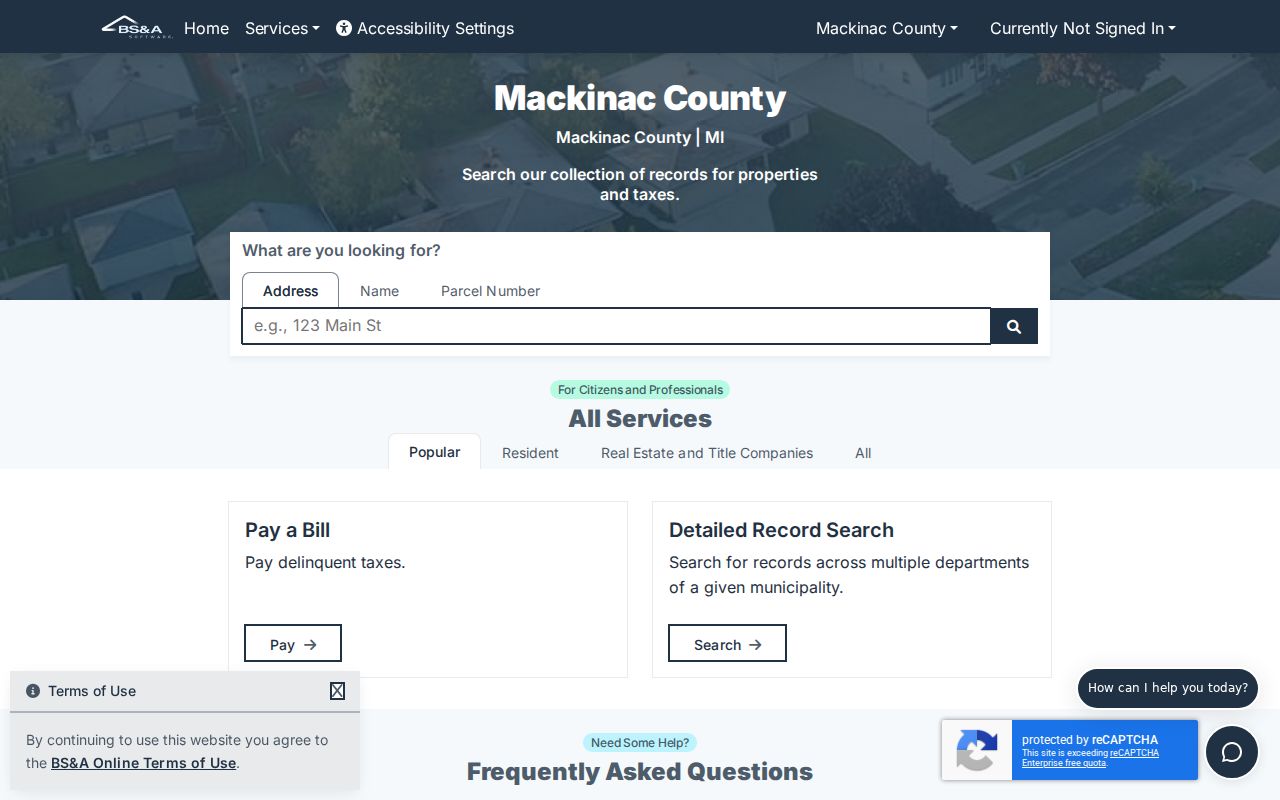
The link does lead to the official BS&A destination. It also shows why phone calls, counter visits, mailed notices, and written records still matter in Mackinac County. A fetched parcel report can carry labels such as MBOR Assessed, Final SEV, Final Taxable, tax history, total due, settlement date, and delinquency. Match the PIN and description to the assessment or tax account first. Only then compare the numbers.
Read Mackinac Delinquency as a Dated Status
For accounts under the Treasurer's administration, the county-linked delinquent-tax payment search offers the most direct route.
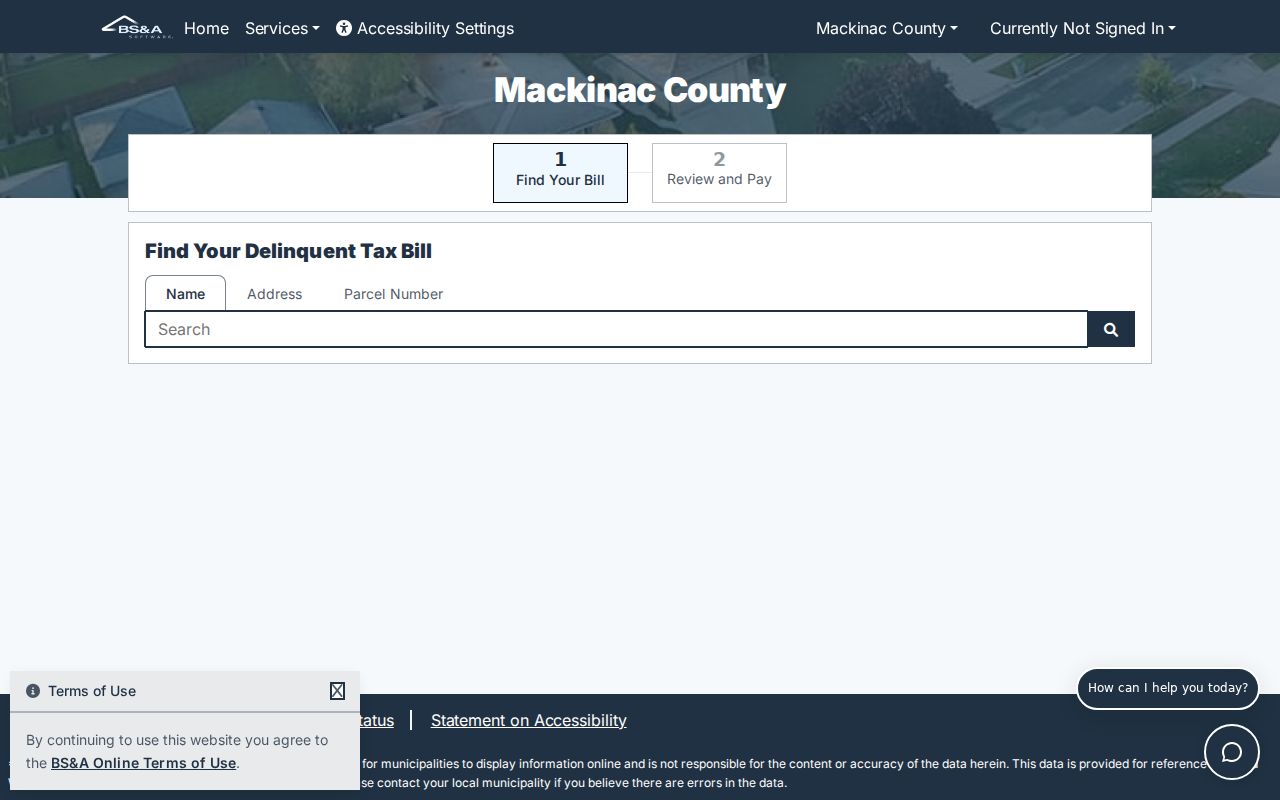
Write down the parcel number, tax year, balance date, and any confirmation you receive. A later payment or statutory action can change the display. The Treasurer's auction page is another source for current delinquency processes.
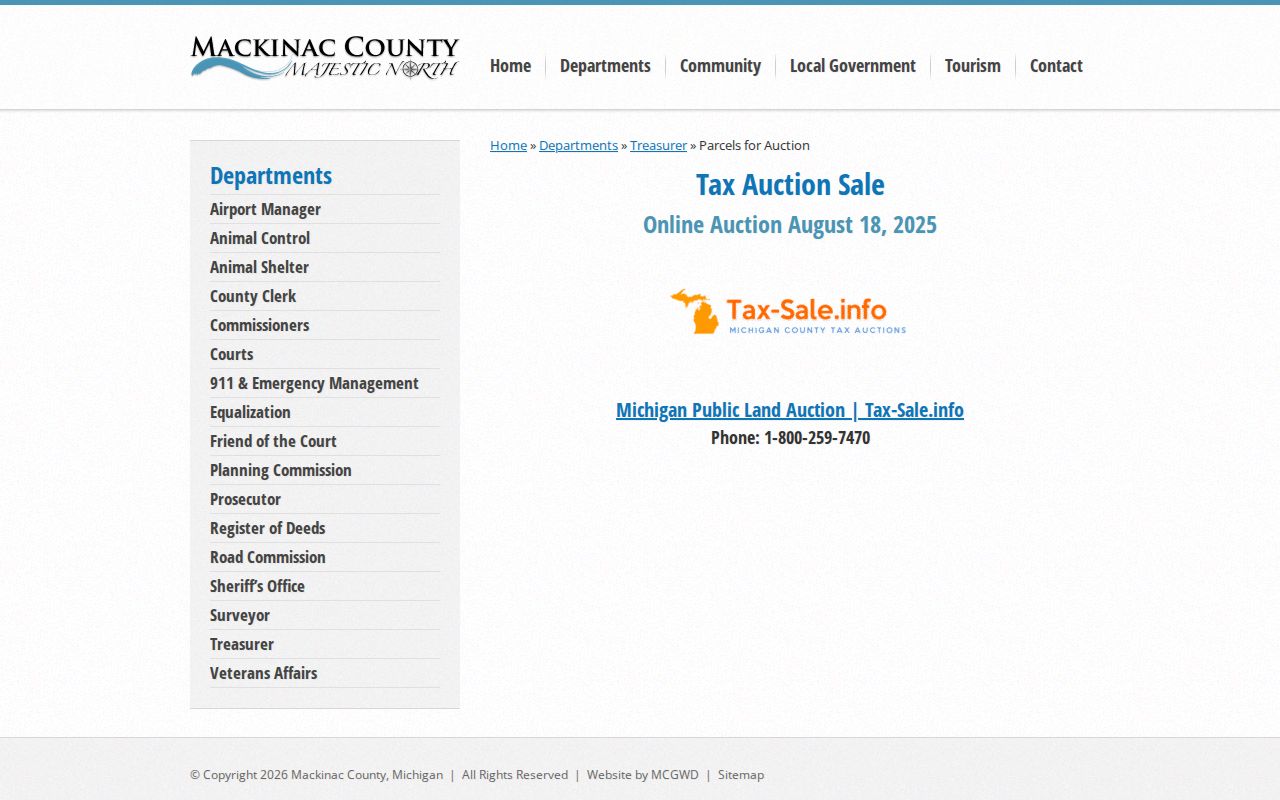
An auction listing is a prompt for deeper work, not a conclusion. Pull the deed records, court files, access documents, condition reports, and boundary surveys before bidding. A listing alone never proves the parcel is still available or that every title issue has been cleared.
Prepare a Mackinac Assessment Appeal File
Start with the current notice and the parcel facts behind it. Note the classification, assessed value, SEV, taxable value, transfer status, and any exemptions. Add the legal or tax description, acreage, and reported improvements. Lay those details beside photographs, measurements, plans, and sales evidence. A factual correction needs different proof than a dispute over value. Keep the two arguments separate.
The local assessor can confirm the Board of Review schedule. The assessor can also say whether that board must come first for your property class. Michigan Treasury's Board of Review forms and instructions supply the statewide paperwork. Tax Tribunal deadlines vary by appeal type. Keep proof of delivery and the written decision.
Use the current calendar. Assessment appeals are deadline-controlled, and a prior year's date is not a reliable substitute for confirmation from the responsible assessor.
Historic Mackinac Tax Rolls Tell a Different Story
The Archives of Michigan county guide lists Mackinac County tax assessment lists covering 1823 through 1826. It also lists later assessment rolls, tax rolls, and tax-sale materials. These records can identify an earlier taxpayer, valuation, land description, or administrative event. They cannot tell you today's account balance. Catalog dates also do not guarantee an unbroken annual series.
Mackinac Island municipal microfilm opens another historical path for island property. Its assessment and tax rolls do too. Library of Michigan county materials, newspapers, and plat books add context for names and shifting descriptions. When citing archival property tax records, include the government unit, series, year, reel or container, and page. That keeps the source distinct from the current roll.